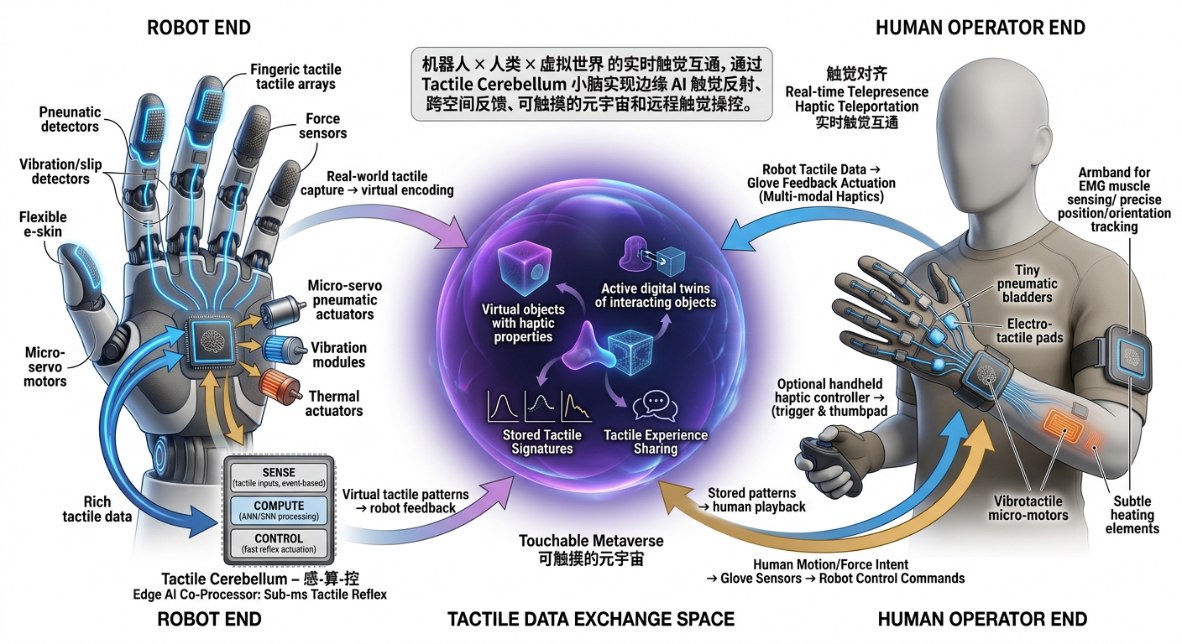
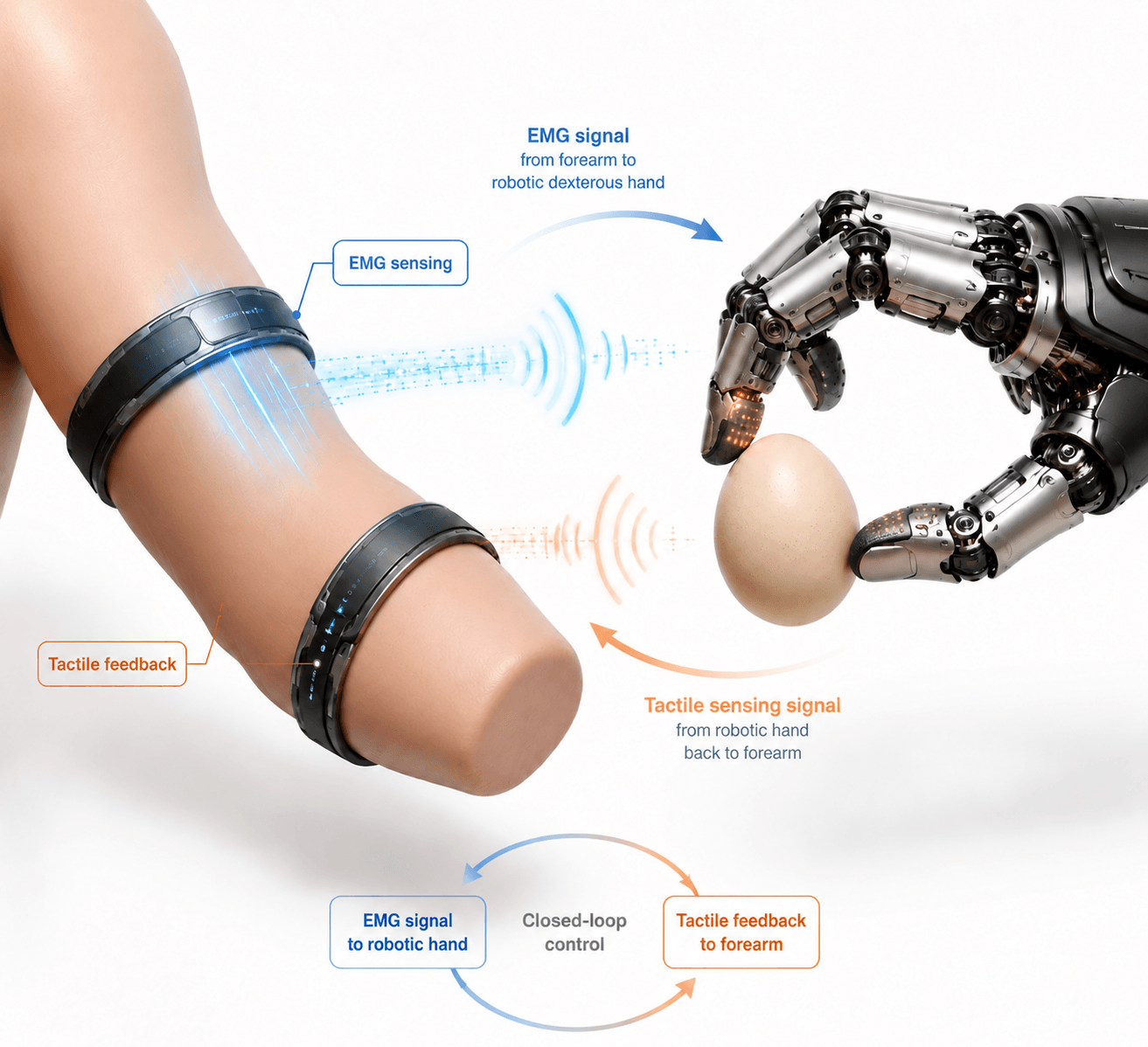
Focused on flexible tactile sensing, on-device tactile computing and robotic applications, we give machines a sense of the physical world that is closer to reality.
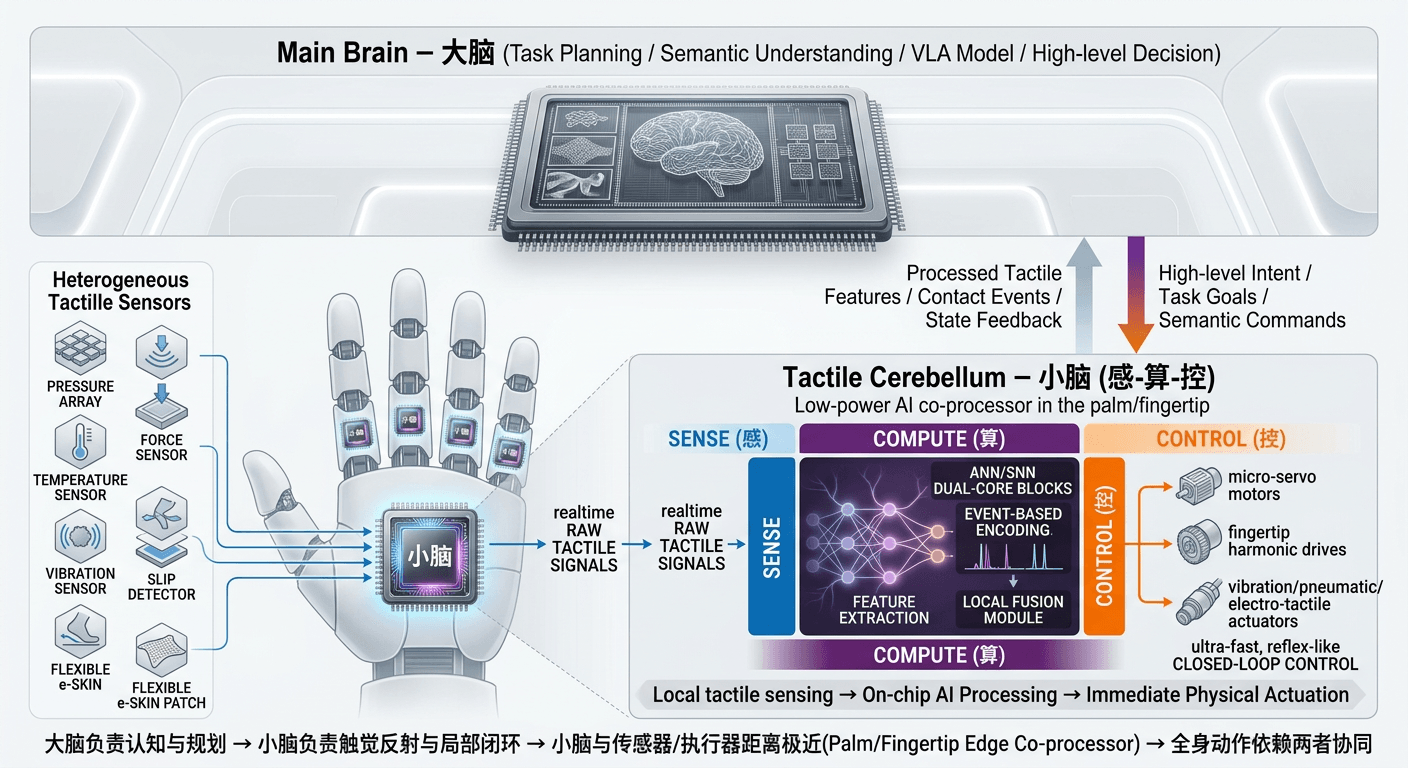
Processing contact, force and slip information locally on the robot itself, helping the robot judge “am I holding it”, “is the grip force right” and “is the object slipping”.
As robots move into factories, homes and public services, “seeing” alone is no longer enough — they also need to sense force, slip and impact when they touch objects before they can perform finer and safer operations. HapticSystem focuses on exactly this link.
HapticSystem builds a complete haptic technology chain from flexible sensing and signal processing to application feedback, so that tactile signals are genuinely used by robot models.
Collects heterogeneous tactile signals such as pressure, force, temperature, vibration, slip and flexible electronic skin, giving robots reliable input the moment they touch an object.
Processes tactile data and performs physical cognition computing on the robot itself, reducing reliance on the cloud and general-purpose compute, and tackling the industry pain points of high power consumption and high latency.
Returns the results to the robot's “main brain”, which handles overall decision-making, forming a closed loop from sensing to motion adjustment, and keeps improving the product through real robotic tasks.
For dexterous hands, humanoid robots and other embodied intelligence devices, we provide tactile information such as pressure, contact and deformation, making grasping and manipulation more stable and safer.
For collaborative robots, industrial inspection, medical wearables and XR haptic interaction, we are open to business, technology and research collaboration.
Built on a fused charge-domain compute-in-memory (CIM) and spiking neural network (SNN) architecture, the NeuC-CIM charge-domain SNN compute-in-memory inference chip reaches an energy efficiency of 1.3 pJ/SOP.
Results published at VLSI 2025Integrates tactile sensing fusion (SENSE), physical cognition computing (COMPUTE) and end-effector feedback control (CONTROL) into a single on-device co-processing chip — the robot's tactile “cerebellum”.
Purpose-built edge computing architecture for hapticsCompletes tactile sensing fusion, physical cognition computing and end-effector feedback control on the device side, forming a local closed loop from contact to motion adjustment without waiting for a cloud round trip.
Processed locally on the device sideProcesses pressure, force, temperature, vibration, slip and flexible electronic skin signals at the same time, reducing the integration and development effort for robot makers working with different tactile sensors.
General-purpose hardware and software platformSpikeRAM lets the tactile chip perform adaptive learning and adjustment on the device side without relying on the cloud, tackling the bottlenecks of tactile models: difficult data alignment and poor cross-device generalisation.
Results published at ISSCC 2026A software toolchain supporting automated TFLite / ONNX deployment, together with an in-house data acquisition system and multimodal data system, significantly shortens the path from model to on-device chip.
Builds a dedicated high-frequency processing path for touch (dual ANN/SNN cores), raising the success rate of dexterous manipulation tasks by about 30 percentage points and solving the problem that touch “cannot be effectively used by models”.
In the upstream white space of “purpose-built haptic edge computing architecture + neuromorphic compute-in-memory chips”, HapticSystem uses neuromorphic compute-in-memory chips as its foundation to integrate sensing, computing, control, data and the toolchain at the system level.
An open hardware and software platform that connects to different types of tactile sensors
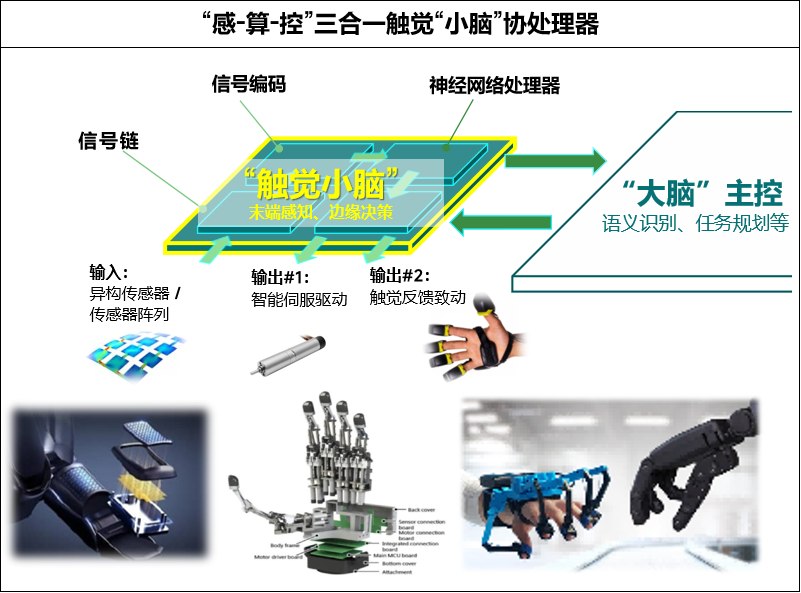
Drawing on the team's long-term experience in sensor signal processing, AI chip design and mass production, HapticSystem aims to connect tactile sensors, robot end effectors and the robot's main brain, so that machines are more sensitive, stable and safe when they come into contact with the real world.
A startup in embodied haptic intelligence and edge co-processing chips, incubated at The Hong Kong University of Science and Technology (Guangzhou) campus.
Its technical direction and innovations have been covered by Xinhua News Agency and other media, and are seen as a viable path to giving robots the tactile sensing capability they lack.
Selected for the “invest-first, convert-later” program, with related technical results published at international integrated-circuit conferences.
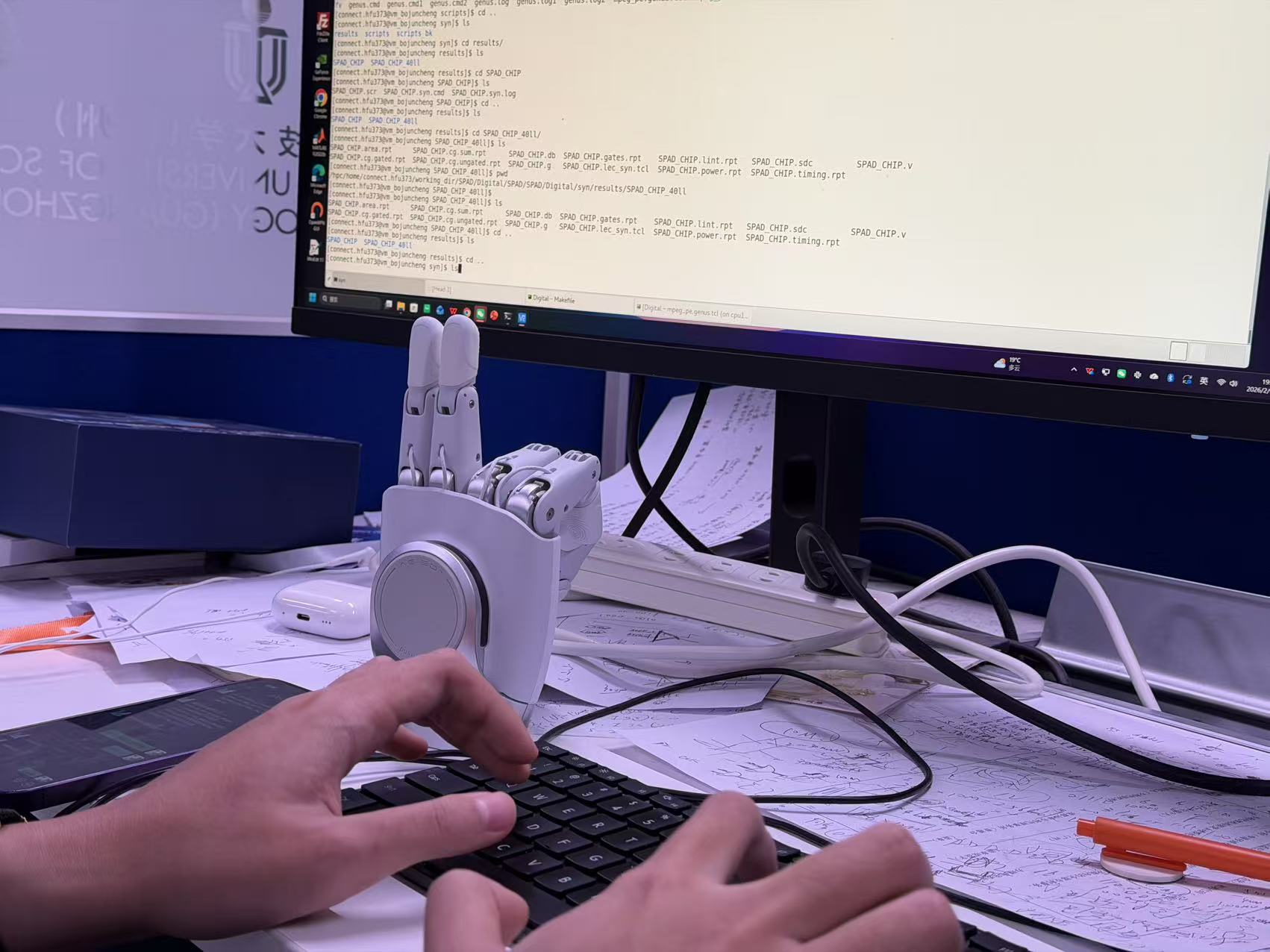
Integrates tactile sensing fusion, physical cognition computing and end-effector feedback control into a single on-device co-processing chip, giving robots local tactile processing capability.
Addressing the massive real-time data processing demands created by full-body tactile arrays on robots, and solving the industry pain points of high power consumption and high latency at the circuit level.
More than a chip: we also provide the software and data that make tactile models actually run, shortening the path from algorithm to the device side.
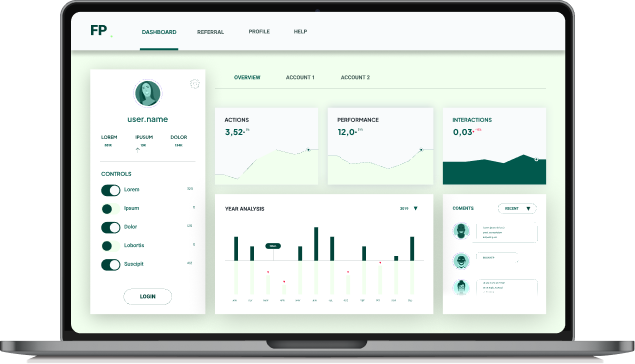
A benchmarking suite for embodied haptic tasks, so that the performance of different tactile approaches can be compared fairly and reproducibly.
From tactile sensor integration and on-device chips to the software toolchain and datasets, HapticSystem provides a complete “chip + toolchain + dataset” solution, together with reference designs and engineering support.
Chip + toolchain + dataset
Universal interfaces for connecting all kinds of tactile devices
Sensing–computing–control (all-in-one) architecture
Energy-efficient computing for the device side
Automated TFLite / ONNX deployment
In-house acquisition and data system
Joint projects and technical services
Whether it is a business partnership, technical integration or research collaboration, you can contact our team directly. If your question is not answered below, please get in touch with us through the Contact page.
We currently offer three: business partnership, technology partnership and research collaboration. Business partnership is aimed at robot OEMs, sensor makers and end application providers; technology partnership is aimed at teams that need to integrate a tactile solution; research collaboration is aimed at universities and research institutions. Please contact us through the Contact page to discuss specific forms of collaboration.
Yes, we support many types. Robots today use a wide variety of tactile sensors with different interfaces and data formats, and HapticSystem connects different tactile devices through a relatively universal hardware and software platform, lowering the integration and development effort for robot makers. The exact compatibility depends on the sensor model, so we welcome you to talk to us with your setup.
[To be confirmed: product status and availability] — please add the chip tape-out status, whether the SDK can be requested for trial use, whether prototyping and evaluation are offered, and how to apply. This item is not yet confirmed, so no commitment is made externally for now.
The project does not only develop chips: it also builds the supporting software tools and algorithm models, and provides reference designs, continuously improving the product through real robotic tasks so that it fits different application needs such as fine grasping, industrial operations and safe human-robot interaction. The scope and timeline of customisation depend on the specific use case.
You can submit a partnership enquiry through the “Contact” page, or email us directly at info@hapticsys.com. We will arrange the right colleague to get in touch with you once we receive it.